
When overwhelm hits, it can be hard to think your way out of it. Grounding offers another place to start, with something you can see, hear, or feel. The texture of your clothing, a sound nearby, or the chair beneath you may help bring your attention back to this moment.
What is grounding?
Think of grounding as an anchor dropped in the present. A sound, a texture, or a point of contact gives you something here and now to notice.
Coping doesn’t mean achieving perfect calm. It means being present enough to make your next caring choice. A grounding tool doesn’t erase a hard feeling. It may offer a little space between the alarm going off and what you do next.
Before you begin
Nobody has to order everything on this menu. You’re just here to see what’s available. There’s no single correct door, and no practice here is a test you can fail.
Psychologists Edward Deci and Richard Ryan describe how having a sense of choice can help us stay with a practice. Give each practice about a minute, or spend your five minutes on just one. There’s no need to finish them all.
Everything here is your choice. You can skip a step, stop partway, or come back later. If a practice feels uncomfortable or makes the overwhelm worse, stop and try another one, or reach out to someone you trust. Skipping is allowed. Going slowly is allowed.
1. Notice what’s around you
Name three things you can see, two things you can hear, and one thing you can feel, like your clothing or the chair beneath you. You can say them in your head or out loud. If one of your senses isn’t easy to use right now, use another. The numbers are just a guide.
If that feels like too much: Let your eyes wander around the room, nice and slow. There’s nothing to count and nothing to find. If your eyes land on something you like, a colour or a bit of light, let them rest there. Or just listen to a sound nearby. You’re here. This room is here. That’s all.
2. Feel the ground beneath you
Rest both feet on the floor, sitting or standing, and gently press down. Or press your palms together, or notice where the chair holds you up. There’s no right way to balance your weight. Just notice where you make contact and what that feels like. Just even, just here.
If that feels like too much: Simply notice the temperature of the air on your skin for a moment instead.
3. Hold something comforting
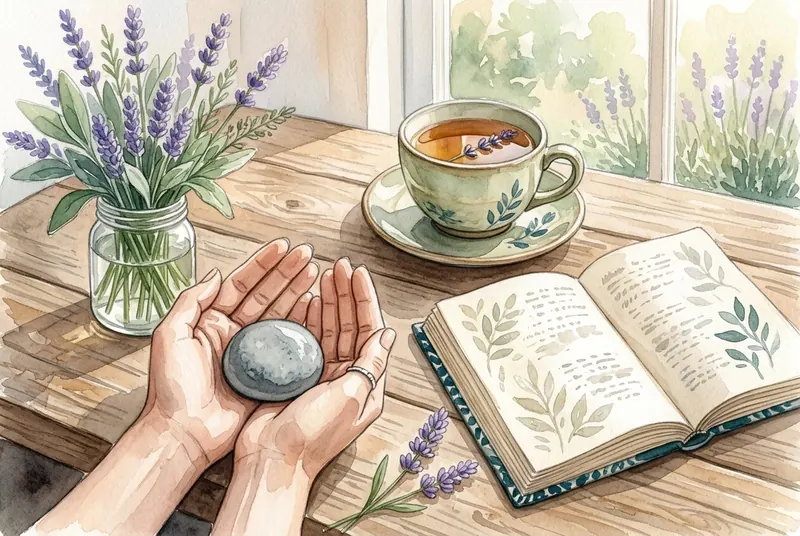
Hold something comforting, like a smooth stone, and notice its texture, temperature, or weight. It doesn’t need to be anything special. Something small enough for a pocket or bag is handy wherever you are.
Some textures, scents, or temperatures may feel uncomfortable rather than soothing. You might have sensitivities or memories connected to them. Noticing that is part of choosing what fits you, not a problem to fix.
This week, try keeping one small comforting object somewhere easy to reach, like a bag or pocket, and notice what it’s like to have it there.
If that feels like too much: Simply picture something meaningful to you for a moment instead.
4. A longer way out
Breathe in gently, then let the breath out a little longer, without pushing it. There’s no need to count or hold your breath. Do this a few times at an easy pace, or just notice your usual breathing.
Researcher Guy Fincham and his colleagues found that breathing practices can help lower stress for many people. Breath doesn’t shut off stress instantly. It turns the dial down, gradually, with practice. A dimmer switch, not an off switch. Some days a slow breath barely registers. That’s okay. Just notice what happens, without forcing a particular feeling.
If that feels like too much: Breathing exercises aren’t for everybody. If this one feels off, skip it and try one of the others. A tool that works wonders for a friend and does nothing for you isn’t proof you’re doing it wrong. It just isn’t your tool.
5. Shake, stretch, settle
Peter Levine, who developed Somatic Experiencing, pointed to how animals in the wild often shake after a scare, as if shaking it off. People aren’t all the same, so gentle movement may or may not help you. It’s worth a try. It can feel a bit like letting out a breath you’ve held too long.
Gently shake out your hands or arms for about thirty seconds, sitting or standing. Then stretch a little: reach overhead or roll your shoulders, whatever suits your body. Last, pause for a few breaths and notice how you feel compared with before. A smaller movement, or just staying still, is fine too.
If that feels like too much: Gently shake your hands for just a few seconds, then let them rest in your lap or at your sides. Notice the difference between moving and resting.
Finding what works for you
Sensory tools don’t work the same for everyone. If one doesn’t land, that’s useful information, not a failure. After trying one, you might ask, “What would help me take my next caring step?” That could mean resting, replying to a message, or reaching out to someone you trust. You don’t have to feel perfectly calm first.
It’s also worth being honest about what a tool does for you. On a scale of 0 to 10, a practice might take you from a nine to a seven, not all the way to zero. That’s just an example, not a target. You might notice a small shift, no shift, or a need for more support. None of those means you’ve failed.
Try a practice on a calmer day, too, when there’s less pressure to make it work. It’s like getting used to the shallow end before swimming in deeper water. A tool you know is easier to reach for when life gets harder. There’s no practice schedule to get right.
And if you forget about these for a while? That’s okay. Life gets busy. Drifting from a tool is like stepping off a path for a while, not falling off a cliff. The path is still there to step back onto.
Grounding at a glance
Notice what’s around you: Three things you see, two you hear, one you feel.
Feel the ground beneath you: Press your feet into the floor, or your palms together.
Hold something comforting: A smooth stone or another small object.
A longer way out: Breathe in gently, breathe out a little longer.
Shake, stretch, settle: Move gently, then rest and notice.
When more support is needed
These practices are here for learning and self-reflection. They aren’t therapy or medical care, and they don’t replace them. If you’re managing a health condition or feel very overwhelmed, please check with a trusted professional before trying anything new. If you need support, please reach out to someone you trust right away.
If you or someone you know is in crisis or in danger, please reach out to emergency services, a crisis line, or a trusted professional right away.
Coming next: The story behind AIM
Grounding gives us somewhere to begin. Next, I’ll introduce Awareness-in-Motion™ (AIM) and the AIM Pathway™—what they are and how they came about. This seven-part series will come out once or twice a week: first the story behind the ideas, then one post for each of the six stages. You’re welcome to follow along at your own pace.
Not sure where to start?
You don’t have to have it all figured out. You’re welcome to book a free 30-minute meet & greet by Zoom, with your camera on or off. It’s a chance to ask questions and see if this feels right for you.
The practices in this post are adapted from A Holistic Wellness Journey™ by Antonia Gattellaro and its companion books, written by Antonia Gattellaro and Kathleen Taylor-Nelson. Both are coming soon.
Sources for this post
Want to read more? Here’s where some of the ideas in this post come from.
Fincham, G. W., Strauss, C., Montero-Marin, J., & Cavanagh, K. (2023). Effect of breathwork on stress and mental health: A meta-analysis of randomised-controlled trials. Scientific Reports, 13, Article 432. Read the study.
Gattellaro, A. (in press). A holistic wellness journey. BookFuel Global Publishers.
Public Health Scotland. (2025, December 9). Grounding exercises. NHS inform. Read the guidance.
SEI Communications. (2011, December 21). Like humans, animals can experience PTSD. Somatic Experiencing International. Read the background discussion.
Theory. (n.d.). selfdeterminationtheory.org. Read the theory overview.